The Painting That Lives Beside the Crosswalk.
What Public Art Owes to People Passing By.
Most paintings announce themselves with a frame. A utility box does the opposite. It stands where a city needs it, somewhere between the kerb, the roadway and a person getting on with their day. It was built to hold equipment, not attention. That is precisely why I find it an interesting place to make art.
I am a California painter, and two of my completed public art commissions are utility-box paintings in Dublin, California: Starry Night of Dublin and Four Seasons of Dublin. They have changed how I think about an artwork’s audience. A person entering a gallery makes at least one deliberate choice: to go inside. A person passing a painted utility box may not have planned to encounter art at all. They may be heading to work, looking after a child, waiting at a light or thinking about something entirely different.
In that setting, a painting should not assume it owns the day.

First, the Object Has a Job
A utility box is not an empty canvas delivered to a studio. It has edges, doors, hardware, an awkward relationship to the ground and more than one face. The viewer rarely sees the entire thing from a single ideal position. There is an approach, a passing glance, a turn, perhaps a second look after crossing the street.
I find that constraint productive. Rather than treating the sides as lesser surfaces, I think about what movement will reveal. Shapes and colours need to remain legible while a person walks. Their relationships cannot depend on the viewer standing in exactly the right spot. The structure keeps reminding the painter that a public artwork belongs to a working place.
That is also an ethical boundary. The box remains equipment. Painting it should make its presence more engaging without pretending the surrounding street, pavement and city functions have disappeared.
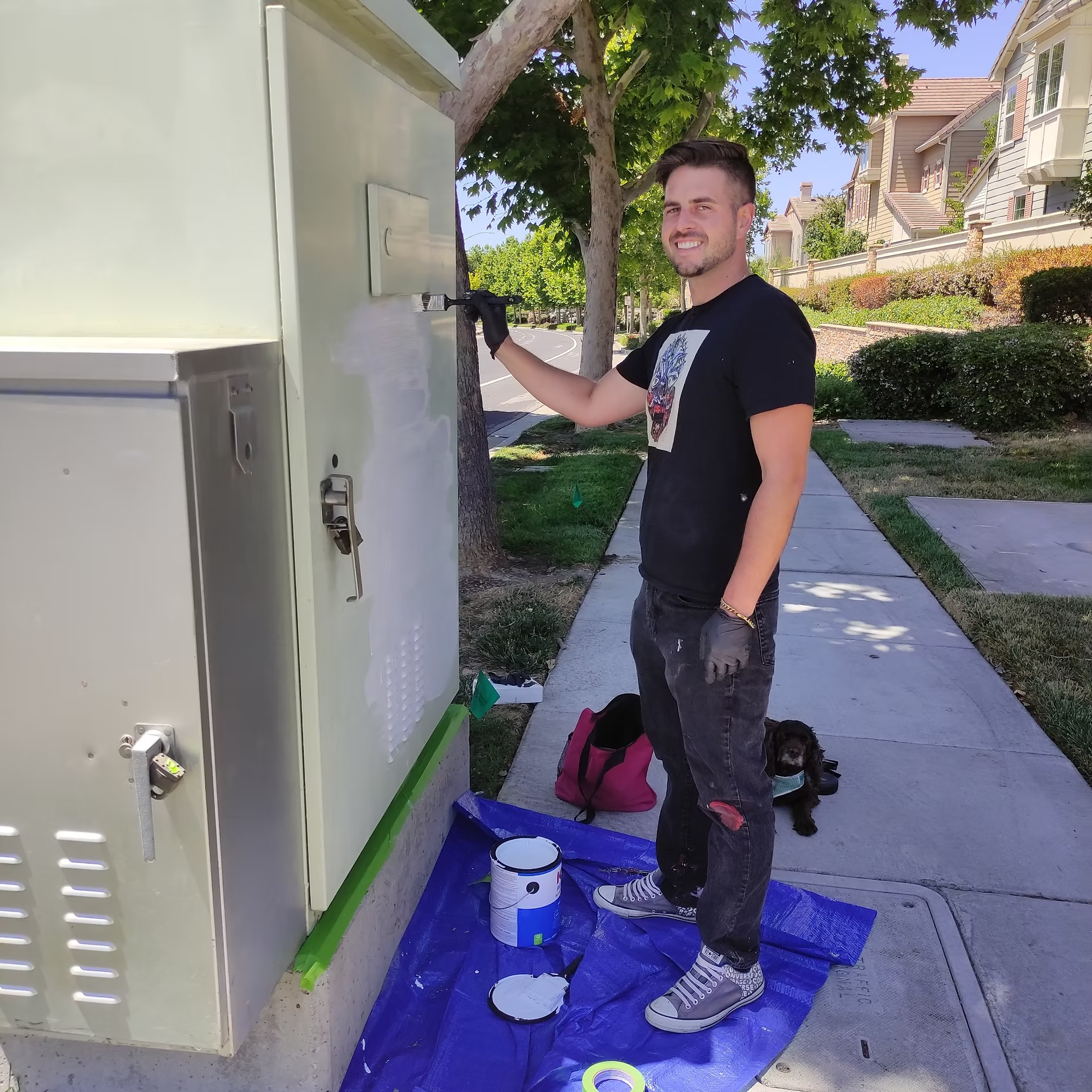
Two Paintings, Two Invitations
With Starry Night of Dublin, I worked in a language of night-blue shapes, rhythmic movement and recognisable imagery. The result operates on two scales. From a distance, its larger areas of blue and yellow offer a pattern to the passing eye. Closer up, the forms ask for a little more time. The work is not a literal replacement for the street around it. It offers another way of noticing a place already there.
Four Seasons of Dublin follows a different kind of movement. Its branches, blossoms, leaves and shifts in colour make a changing year visible on a structure that stays put. One side catches a moment of spring; another opens onto warmer colours. The box does not have to depict a complete landscape panorama to evoke one. A branch, a patch of sky or a field of colour can give someone a momentary way into the larger environment.
I am interested in the recognisable without insisting on photographic imitation. Painterly layers and flowing marks can carry a familiar subject while keeping the fact of painting visible. In public, that visibility matters. It leaves room for the person who sees the work to interpret rather than merely confirm what they already know.


A Small Interruption Can Be Enough
Public art is sometimes asked to justify itself through enormous claims: that it will transform a neighbourhood, repair social divisions or produce civic pride on command. I am wary of putting that burden on a single painted object. A painted utility box cannot solve a city’s problems. What it can do is alter one encounter.
Research offers useful context, with important limits. A 2025 study of a pedestrian-level art exhibition in Berlin found that participating viewers reported increased neighbourhood connection and wellbeing after engaging with the exhibition. The study involved 64 participants and a different kind of art experience, so its findings should not be taken as proof of what my paintings cause in Dublin. They do, however, suggest that everyday visual encounters are worth studying seriously.
A separate 2026 study of murals in Philadelphia found that murals could improve how participants perceived aspects of their neighbourhoods. Again, that is not a measurement of my work. It is a reminder that the surfaces people move past can influence the character of a place.
For me, the most valuable change may be smaller and harder to tally: somebody notices a familiar corner differently. Somebody sees that an ordinary object received an extraordinary amount of consideration. Even someone who dislikes the colours has been given a reason to look again.

Painting for People Who Did Not Ask for a Painting
A public artist has an audience that cannot simply opt out by avoiding the gallery. That calls for humility. People have different histories with a place, different visual tastes and different reasons for occupying a street. One resident may love a bright field of colour; another may prefer the box to disappear into its surroundings. An artwork can be generous without expecting universal agreement.
This changes how I approach composition. I look for openness rather than an instruction manual. A readable image can welcome somebody quickly, while its marks, transitions and details reward closer attention. A pedestrian does not need specialised art vocabulary to begin. Nor does the work have to deny its complexity to be welcoming.
I also think about an often-overlooked collaborator: the place itself. Weather, architecture, nearby plantings, traffic and shifting light alter what an artwork looks like from one hour to another. The same painted colours can feel different against a clouded sky or in hard afternoon sun. The artwork remains physically stable, but its encounter is never exactly repeated.

The Street Is a Living Exhibition
As an artist and educator, I am interested in helping people recognise creativity as something they can participate in, not a remote skill reserved for experts. A painting on civic infrastructure can quietly reinforce that idea. Art does not exist only behind a ticket desk or on a museum wall. It can meet us at the ordinary scale of a walk.
That proximity also makes me think about the uncelebrated work behind public art: the people who commission it, maintain its setting and keep a street usable. A successful painting should not erase those systems. It can make us more attentive to the designed and cared-for environment we normally overlook.
I still value the concentration of a studio and the deliberate encounter of an exhibition. But an artwork in the street asks me a different question: how much can I offer someone who has only a few seconds?
The answer is not always a grand statement. Sometimes it is a clear movement of blue, a flowering branch or an unexpected patch of colour on the way to somewhere else. Public painting does not need to interrupt a person’s life for long to become part of their picture of a place.

About the Author
Beau James Thomas is a California painter, public artist, author and educator. He holds an MFA in Studio Art from Mills College and has completed public art commissions in Dublin, California. His practice combines expressive, layered colour with recognisable subjects and stories drawn from everyday places.
Website: https://BeauThomasArt.com
Instagram: @BeauThomasArt
Research References
On the Impact of Public Art: How Engaging a Pedestrian-Level Exhibition Improves Neighborhood Connectedness and Well-Being. Wellbeing, Space and Society, 2025.
https://doi.org/10.1016/j.wss.2025.100252
Murals and Neighborhoods: The Impact of Public Art in Philadelphia. Cities, 2026.